Don't miss our Limited-time offer - up to 20% OFF!

The Legend of Cleopatra’s Pearl: How A Single Gem Redefined Luxury For 2000 Years

For over two millennia, no story has captured the mythic power of pearls quite like that of Cleopatra VII, the last active ruler of the Ptolemaic Kingdom of Egypt, and her legendary pearl wager. It is a tale that has been told by historians, poets, and artists for centuries, and it forever cemented pearls as the ultimate symbol of wealth, power, and unapologetic elegance. To this day, it remains the most famous pearl story ever told—and it reveals more about the timeless allure of pearls than you might expect.
The story, first recorded in 77 AD by the Roman natural philosopher Pliny the Elder in his landmark work Natural History, unfolds during the height of Cleopatra’s romantic and political alliance with Mark Antony, the Roman general and triumvir. Mark Antony, known for his love of opulence and grand spectacle, had long mocked the excess of the Egyptian court, claiming that Cleopatra could never truly match the grandeur of Rome’s feasts and riches. Cleopatra, ever the strategist, issued a bold wager: she would host the most expensive dinner in history, a single meal that would cost the equivalent of 10 million sesterces—enough to feed an entire Roman city for a year. Mark Antony, amused and skeptical, accepted the bet, certain that no meal could ever be worth that sum.
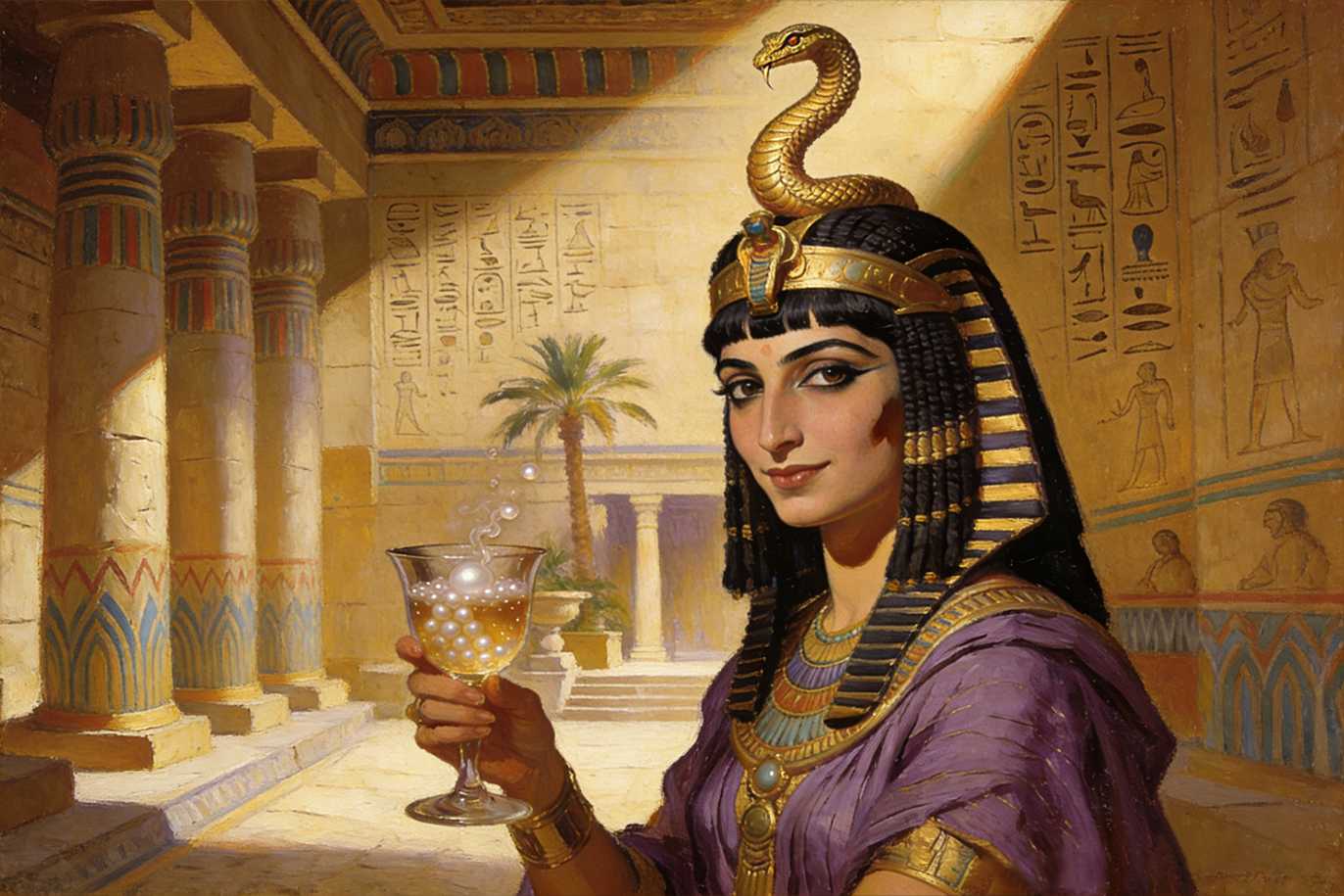
The night of the dinner arrived, and Mark Antony sat down to a lavish, but not unprecedented, feast. He laughed, telling Cleopatra that she had already lost the wager; the meal before them was impressive, but nowhere near the fortune she had promised. Cleopatra smiled, and told him that the main course had not yet arrived. She signaled to her servant, who brought a single goblet of sour wine vinegar to the table. Then, from her ear, she removed one of the two enormous, priceless pearl earrings she wore—pearls that had been harvested from the Red Sea, the largest and finest of their kind ever found in the ancient world.
What happened next has become the stuff of legend. Cleopatra held the pearl up for Mark Antony to see, then dropped it into the goblet of vinegar. The acetic acid in the vinegar slowly dissolved the calcium carbonate of the pearl, turning the wine into a cloudy, iridescent liquid. Once the pearl had fully dissolved, Cleopatra lifted the goblet, toasted Mark Antony, and drank the entire contents in one sip. In that single moment, she had consumed the entire fortune she had promised—winning the wager, and proving that her wealth and power were beyond anything Rome could imagine.
Pliny the Elder, who recorded the story from eyewitness accounts of the Roman court, wrote that the second pearl from the pair was later cut in half and made into earrings for the statue of Venus in the Pantheon at Rome, a final testament to their unparalleled value.
To understand why this story has endured for 2000 years, you have to understand what pearls represented in the ancient world. Unlike gold, silver, or mined gemstones, pearls could not be carved, forged, or extracted from the earth. They were a gift from the sea, formed by living creatures, found only by chance in the depths of the ocean. To own a large, flawless pearl was not just a sign of wealth—it was a sign that you had the power to command the rare, unknowable gifts of nature itself. For Cleopatra, the pearl was more than jewelry: it was a political tool. In drinking the dissolved pearl, she sent a clear message to Rome: I have so much power, so much wealth, that I can destroy a treasure beyond your wildest dreams in a single moment, just to win a bet.
This story was only the beginning of pearls’ reign as the gemstone of kings and queens. For centuries after Cleopatra’s death, pearls remained the ultimate symbol of royal power. In Renaissance England, Queen Elizabeth I was so obsessed with pearls that she covered her gowns, headdresses, and even her gloves with them, earning the nickname “The Pearl Queen.” She saw pearls as a symbol of her purity, her power, and her status as the unmarried “Virgin Queen” of England. In 18th century France, Marie Antoinette owned a collection of pearls so vast and valuable that it became a symbol of the monarchy’s excess—including a double-strand pearl necklace that sold at auction in 2018 for $36 million, over 200 years after her death.
What makes this story so relevant today, in 2026? It’s that the core allure of pearls has never changed. We no longer see pearls as a symbol of absolute royal power, but we still see them as a symbol of timeless elegance, quiet luxury, and unshakable confidence. Cleopatra’s pearl was a statement of who she was: a woman of immense power, intelligence, and grace, who refused to be underestimated. And that is exactly what pearls represent for women (and men) today.
A pearl is not just a gemstone. It is a story. It is a statement. It is a piece of the sea, formed by life, carrying with it 2000 years of history, legend, and power. When you put on a pair of pearl studs, or a pearl necklace, you are not just wearing jewelry—you are connecting yourself to a legacy that stretches back to the banks of the Nile, to the courts of queens, to the most legendary stories ever told.
At Pearlith, we honor that legacy with every piece we create. Every pearl in our collection is hand-selected for the same exceptional quality, the same radiant luster, that made Cleopatra’s pearl the stuff of legend. We believe that every pearl tells a story—and we want to help you write yours.