Don't miss our Limited-time offer - up to 20% OFF!

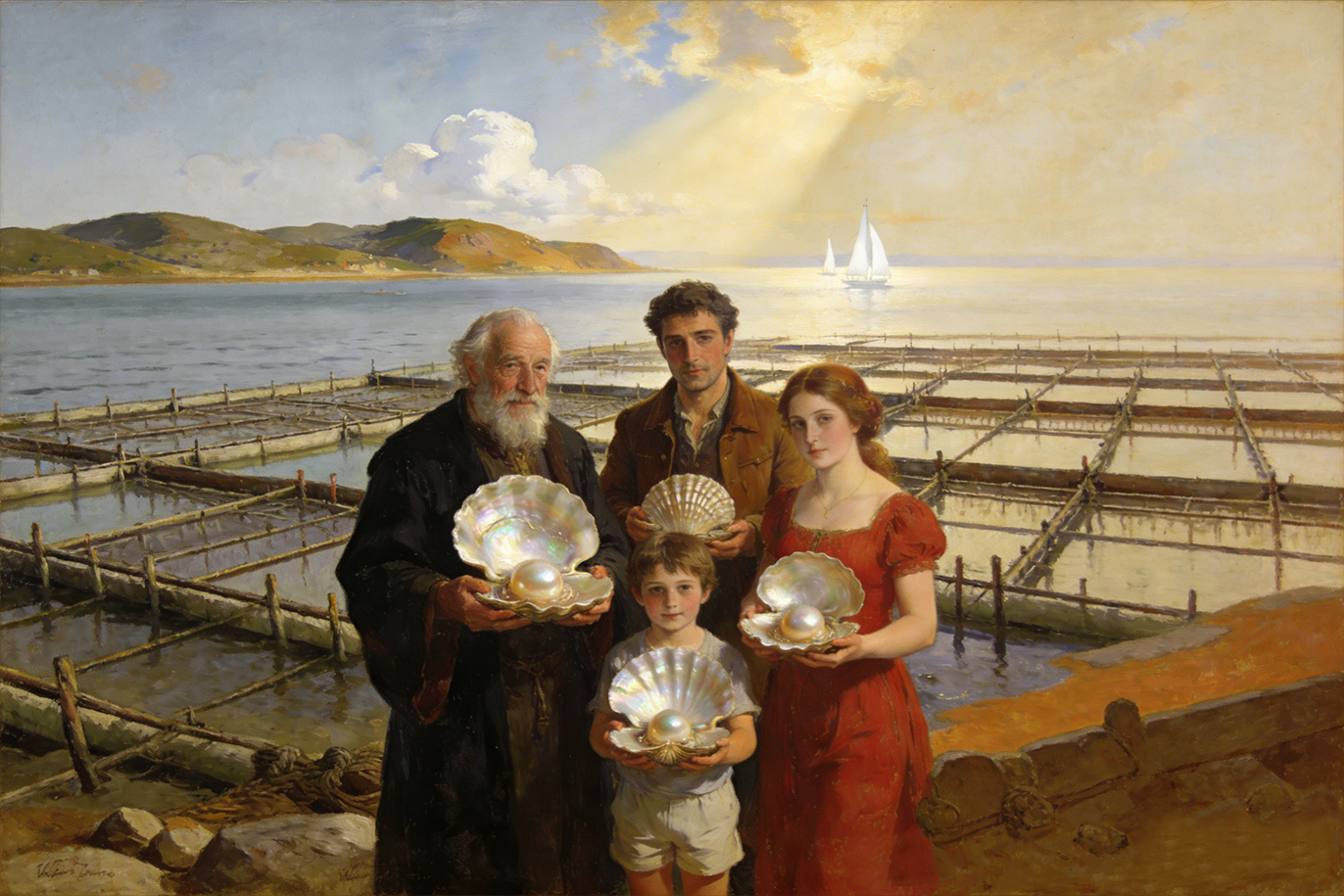
The Hands That Grow Pearls: A 4-Generation Family’s Legacy In Japan’s Akoya Pearl Farms

When you look at a perfectly round, mirror-lustered Akoya pearl, you see the finished product: a tiny, radiant gem, the gold standard of fine pearl jewelry. What you don’t see is the 5 years of relentless work, the generations of knowledge, the heartbreak of typhoons and warming seas, and the quiet devotion of the farmers who grow it. For over 70 years, the Sato family has tended to Akoya pearl oysters in the calm, nutrient-rich waters of Japan’s Ise Bay, the birthplace of cultured pearls. Their story is not just a story of pearl farming—it’s a story of legacy, respect for nature, and the unwavering pursuit of perfection that turns a tiny oyster into a treasure.
The story of the Sato family begins in 1952, with Hiroshi Sato, a young fisherman from a small village on the coast of Mie Prefecture. Before World War II, Mie Prefecture was already famous as the home of Mikimoto Kokichi, the man who perfected the art of cultured Akoya pearls in the 1890s, and revolutionized the pearl industry forever. But the war had devastated Japan’s pearl farms. Boats were seized, oyster beds were destroyed, and the knowledge of pearl farming was at risk of being lost forever. Hiroshi Sato, who had grown up watching the pearl farmers work, was determined to bring the industry back to life.
He spent 3 years as an apprentice to one of the few remaining master pearl farmers from Mikimoto’s original team, learning every detail of the craft: how to select the healthiest Akoya oysters, how to perform the delicate nucleation surgery that starts the pearl’s growth, how to tend to the oysters through every season, and how to harvest the pearls with care, without damaging the oyster or the gem inside. It was a craft that demanded patience, precision, and a deep respect for the sea. In 1955, Hiroshi launched his own small pearl farm, with just 5,000 oysters and a single small boat.
What Hiroshi learned in those early years, and what he passed down to his son, his grandson, and his great-granddaughter, is that pearl farming is not manufacturing. It is a partnership with nature. An Akoya pearl takes, on average, 4 to 5 years to grow from start to finish. The process begins with raising young oyster spats, which are grown in protected nursery waters for 2 years, until they are strong enough to survive the nucleation process. Nucleation is the most delicate step in the entire process: a skilled technician inserts a tiny, perfectly round mother-of-pearl bead nucleus, along with a small piece of mantle tissue from a donor oyster, into the gonad of the host oyster. If the oyster accepts the nucleus, it will begin to coat it with layer upon layer of nacre, the iridescent organic substance that becomes the pearl. If it rejects it, the oyster will die.
Even today, with all the advances in modern technology, only about 30% of nucleated Akoya oysters will survive and produce a pearl. Of those 30%, only 5% will produce a gem-quality pearl, with the mirror-like luster, thick nacre, and flawless surface that makes Akoya pearls famous around the world. For Hiroshi Sato, this was the lesson at the heart of the craft: you cannot control the sea. You can only care for the oysters, respect the water, and wait.
Hiroshi’s son, Kenji Sato, took over the farm in 1978, at a time when the Japanese pearl industry was facing new challenges. Global demand for Akoya pearls was booming, but mass production was starting to flood the market with low-quality pearls. Many farms were cutting corners: nucleating oysters too young, harvesting pearls too early, sacrificing nacre thickness for faster production and higher yields. Kenji refused to follow suit. He doubled down on his father’s commitment to quality, keeping the farm small, and focusing on growing only the highest-quality pearls, even if it meant lower yields and smaller profits.
“Pearls are not a commodity,” Kenji would say to his team. “They are a gift from the sea. If you rush them, you dishonor the oyster, the water, and the people who will wear this pearl for the rest of their lives.” It was a decision that cost him in the short term, but it earned the Sato family a reputation among the finest pearl jewelry brands in the world as a source of exceptional Akoya pearls.
In 2001, Kenji’s son, Takashi Sato, took the reins of the farm, and faced a new, unprecedented challenge: climate change. Rising sea temperatures in Ise Bay were causing outbreaks of oyster disease, and more frequent and intense typhoons were destroying oyster beds, wiping out entire years of work in a single storm. In 2004, a super typhoon hit the bay, destroying 80% of the Sato family’s oyster stocks. It was a devastating loss, one that would have forced many farms to close. But Takashi refused to give up.
He worked with marine biologists from the University of Mie to develop more sustainable farming practices: moving oyster lines to deeper, cooler waters during the summer months, developing disease-resistant oyster stocks, and reducing the farm’s environmental footprint to protect the delicate ecosystem of the bay. He also doubled down on the family’s commitment to slow, careful farming, refusing to rush the growth process, even when it took years to rebuild their stocks. “The sea has given our family everything,” Takashi said at the time. “It is our responsibility to care for it, even when it is hard.”
Today, the Sato family farm is run by Hana Sato, the great-granddaughter of Hiroshi Sato, the first woman to lead the family business in its 70-year history. Hana grew up on the water, helping her father and grandfather tend to the oysters, learning the craft from the time she was a child. She has brought new energy to the farm, launching a direct-to-consumer line of pearls, and educating young people about the history of Akoya pearls and the importance of sustainable ocean farming. But she has never strayed from the core principles that her great-grandfather established 70 years ago: respect for the sea, unwavering commitment to quality, and the belief that every pearl is a living, breathing piece of the ocean, with a story to tell.
When we visited the Sato family farm at Pearlith, we sat with Hana on the deck of her small boat, watching as her team pulled oyster lines from the bay, cleaning each oyster by hand, removing barnacles and seaweed to keep them healthy. She held up a small Akoya oyster in her hand, and said something we will never forget: “People see the pearl, and they think it is perfect. But perfection is not the point. The point is the journey. Every layer of nacre is a day in the life of this oyster. Every storm, every warm summer, every cold winter, is in that pearl. When someone wears it, they are not just wearing a gem. They are wearing 5 years of our family’s work, and the life of this oyster, and the story of the sea.”
That is the magic of pearls. It is not just their beauty. It is the life, the legacy, the hands that grew them, the sea that formed them. At Pearlith, we are proud to source our Akoya pearls exclusively from the Sato family farm, and other small, family-run farms like theirs, who share our commitment to quality, sustainability, and honoring the legacy of pearl farming. When you wear an Akoya pearl from our collection, you are not just wearing jewelry. You are wearing a 70-year family legacy, a piece of the Japanese sea, and the quiet devotion of the hands that grew it.